SMT vs THT Assembly: Which Process Is Right for Your PCB?
When you send a PCB design to a manufacturer, one of the first decisions is: surface mount (SMT) or through-hole (THT) assembly? The answer shapes your cost, reliability, board size, and even which components you can use. This guide breaks down both technologies so you can make the right call.
What Is SMT Assembly?
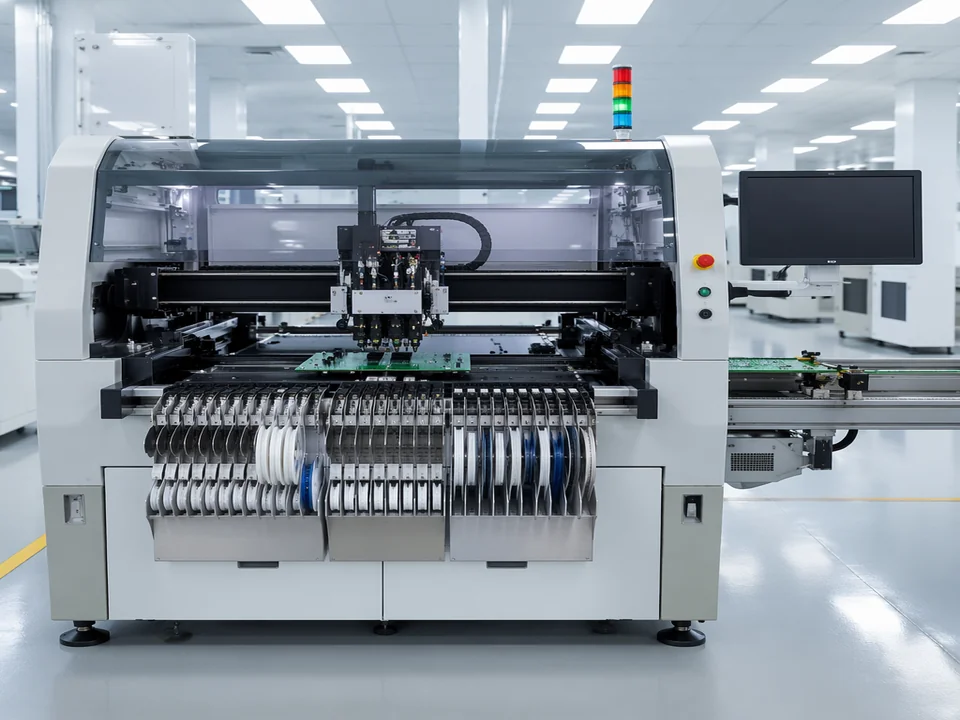
Surface Mount Technology places components directly onto the surface of a PCB. Components — called SMDs (Surface Mount Devices) — have small metal tabs or end caps that sit on copper pads. Solder paste is printed onto the pads, components are placed by high-speed machines, and the entire board passes through a reflow oven to create permanent solder joints.
SMT dominates modern electronics. Your smartphone, laptop, and IoT device are almost entirely SMT. The technology supports components as small as 0201 (0.6mm × 0.3mm) and fine-pitch BGAs with hundreds of balls.
What Is THT Assembly?
Through-Hole Technology inserts component leads through drilled holes in the PCB. The leads are soldered to pads on the opposite side — traditionally by wave soldering (the board passes over a wave of molten solder) or by selective soldering for mixed-technology boards.
THT is older but far from obsolete. It remains the go-to for components that need mechanical strength: connectors, transformers, large capacitors, and power devices that experience physical stress.
Head-to-Head Comparison
| Factor | SMT | THT |
|---|---|---|
| Component size | 0201 (0.6mm) and up | Typically ≥ 2.54mm pitch |
| Board density | Very high — both sides usable | Lower — holes consume routing space |
| Assembly speed | 80,000+ CPH per line | Slower — manual or wave process |
| Mechanical strength | Moderate | Excellent — leads anchor through board |
| Cost at volume | Lower — full automation | Higher — more manual steps |
| Rework difficulty | Requires hot air / specialized tools | Easier — accessible leads |
| Prototype cost | Higher setup, lower per-unit | Lower setup for small batches |
When to Choose SMT
- High-volume production. If you're making 1,000+ units, SMT's automation advantage is decisive.
- Space-constrained designs. Wearables, IoT sensors, and compact consumer devices need SMT density.
- High-frequency circuits. Shorter lead lengths = less parasitic inductance. RF and high-speed digital designs are nearly all SMT.
- Fine-pitch ICs. BGAs, QFNs, and 0.4mm-pitch components can only be assembled via SMT.
When to Choose THT
- High-power applications. Power supplies, motor controllers, and industrial equipment where components handle significant current and need robust mechanical anchoring.
- Connectors subject to physical stress. USB, barrel jacks, and terminal blocks that users plug and unplug repeatedly.
- Prototyping and hobbyist projects. THT components are easier to hand-solder and breadboard.
- High-reliability mil/aero. Some military and aerospace specs still require through-hole for vibration resistance.
The Reality: Mixed Technology
Most real-world PCBs use both SMT and THT. A typical industrial controller has SMT ICs and passives alongside THT connectors and power devices. Modern assembly lines handle mixed technology seamlessly: SMT components are placed and reflowed first, then THT components are inserted and soldered via selective wave or hand soldering.
At uppcba, every SMT line is complemented by THT capability. We handle the full spectrum — single-sided SMT, double-sided, and mixed-technology boards — all under one roof.
Not sure which process your design needs?
Send us your BOM and we'll provide a DFM review with assembly recommendations — free, within 24 hours.
Request a Quote